 Analyst Bootcamp
The ticket that cannot be started
Add a "Pay later" option to checkout.
That is a real ticket, and it is unbuildable as it stands. Not because it is short, but because every reader fills the gaps differently: the developer assumes a third-party provider, the designer assumes a new step in the flow, finance assumes a credit check they were never asked about. A Junior+ analyst's job is to get the gaps filled before the sprint starts, with as few meetings as possible.
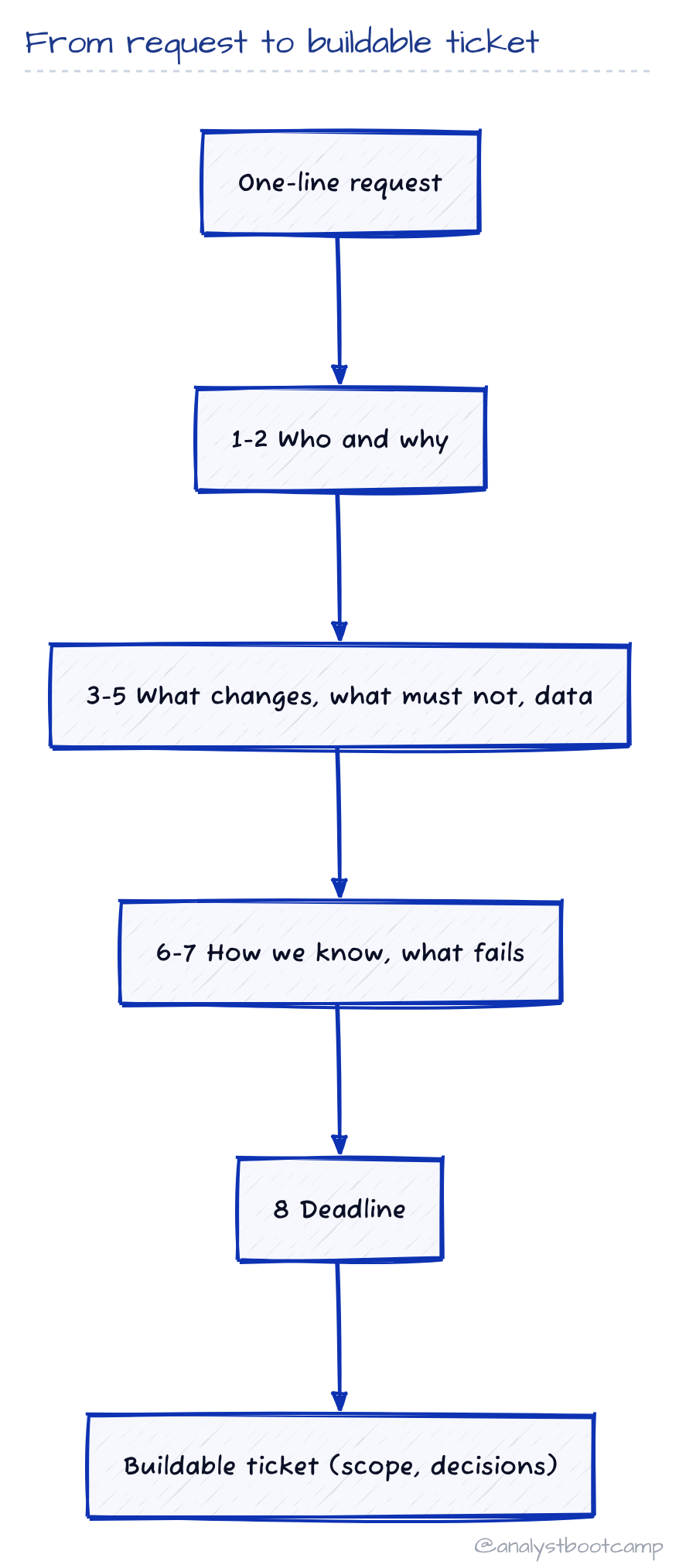
The way to do that is not "ask more questions". It is to ask the right eight questions, in order, and to write the answers where the team will read them.
The eight questions
| # | Question | Why it matters | Typical answer that changes the work |
|---|---|---|---|
| 1 | Who asked, and who will use it? | Different owners want different things from the same words | "Marketing asked; it is for new customers only" |
| 2 | What problem does it solve today? | Lets you propose a cheaper solution | "Cart abandonment at the payment step is 38%" |
| 3 | What changes for the user, step by step? | Turns a noun ("option") into behaviour | "A new choice on the payment page, then a redirect to the provider" |
| 4 | What must not change? | The invisible constraints: legal, finance, existing flows | "Refunds must still go through our own flow" |
| 5 | Where does the data come from, where does it go? | Finds integrations and fields early | "The provider returns a decision we need to store" |
| 6 | How will we know it worked? | Gives you the acceptance criteria and the metric | "Pay-later share of orders, abandonment on that step" |
| 7 | What happens when it fails? | The unhappy paths nobody mentions | "Provider declines, provider times out, customer closes the tab" |
| 8 | What is the deadline and why? | Scope depends on it | "Before the November campaign" |
You will rarely get all eight answered in one go. The point is that you know which ones are still open, and you can say so in one message instead of guessing.
How to ask so that people answer
Three habits separate analysts who get answers from analysts who get "let's set up a call".
Ask about the past, not the future. "What did customers do last month when they could not pay?" gets facts. "Would customers use pay later?" gets opinions. This is the core idea of The Mom Test: people are reliable about what they did and unreliable about what they would do.
Offer a concrete option to react to. Instead of "What should happen on decline?", write: "Proposal: on decline we show the other payment methods and keep the cart. Objections?" A wrong proposal gets corrected in minutes; an open question waits for days.
Batch and number. One message with five numbered questions beats five chat pings. The reader can answer 1, 3 and 5 and delegate 2 and 4. Put the questions in the ticket, not only in chat, so the answers are findable in three months.
To: Product owner (Anna), cc: Payments lead (Marco)
Re: PAY-412 "Pay later" at checkout — 5 questions before refinement

1. Scope: new customers only, or everyone? (Marketing brief says "new")
2. Provider: is Klarna decided, or do we evaluate? (affects integration effort)
3. Decline: proposal = show other methods, keep cart. OK?
4. Refund path: through our flow as today, or through the provider?
5. Reporting: do finance need pay-later orders separated in the daily export?
Deadline assumed: 10 Nov (campaign). Correct me if not.
Where the answers go
Answers that stay in chat are lost. Put them into the ticket in a fixed shape:
- Context (two or three sentences: who, why, numbers).
- In scope / out of scope (bullets; out of scope is the more valuable half).
- Decisions with the name of the person who decided and the date.
- Open questions with an owner and a date.
A ticket with an empty "Open questions" section is ready for refinement. One with three open questions is not, and everyone can see it without a meeting.
The traps
- Answering your own questions. You "know" refunds go through your flow, so you do not ask. Six weeks later the provider's contract says otherwise. If the answer is not written by its owner, it is an assumption: label it as one.
- Asking about solutions before problems. "Which provider?" before "what problem?" locks the team into one option. Question 2 before question 3, always.
- Treating silence as agreement. No reply to "Objections?" is not a decision. Write "Assumed X on 14 Oct, no objection received" and move on; it is honest and it is reversible.
- Collecting wishes. When a stakeholder adds "and it would be great if…", put it under Out of scope (parked). It is kept, it is visible, it is not in the sprint.
With AI
A model is a good question generator: paste the ticket and ask for "questions a developer, a tester and a finance person would ask". Expect 60% noise, 40% useful, and one or two you would have missed. It is a poor answer source: it does not know your refund policy, your provider or your deadline. Use it to prepare the list, never to fill it in.
Try it (5–10 minutes)
Take this request: "Let managers export the team's timesheets."
- Write the eight questions for it. For each, guess the answer you expect and mark the guess as an assumption.
- Turn three of them into proposals ("Proposal: CSV with one row per day per person. OK?").
- Draft the numbered message to the requester (max 120 words). Read it as the requester: can every question be answered in one line?
Where this shows up in real work
- Junior and Junior+ BA job posts list "gather and document requirements from stakeholders" first; the interview exercise is usually a vague request you must question on the spot.
- In real backlogs the state "blocked: waiting for clarification" is where most junior tickets sit; the numbered-questions message is what moves them.
- Freelance briefs ("we need a feature like X") are won by the first reply that asks three precise questions instead of quoting a price.
Sources worth reading
Practice it on real drills
Elicitation: questions for stakeholdersConflicting stakeholder requirementsEnd-to-end feature spec (business + system)