 Analyst Bootcamp
The request that is too big to start
"Our ticketing tool does not work for us any more. We need a new one."
Everything about that sentence is a feeling. A gap analysis turns it into facts: which capabilities are needed, which the current tool has, which it lacks, and what each gap costs. At the end you may still buy a new tool, but you will know why, and the vendor demo will not decide it for you.
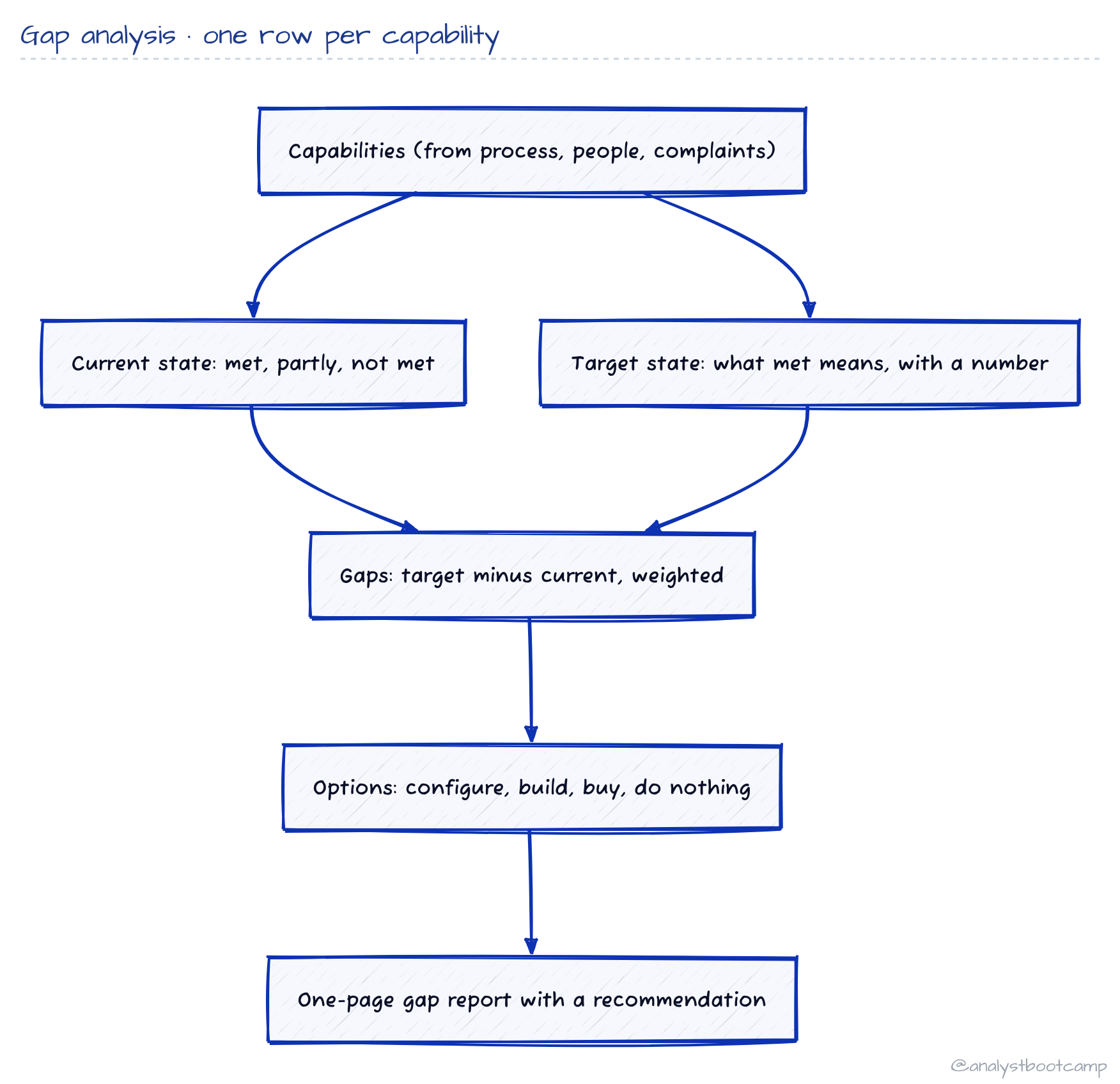
The method has five steps and fits in two or three days for a typical internal tool.
Step 1: the capability list, not the feature list
List what the business needs to do, not what the tool should have. "Assign a ticket to a team based on category" is a capability; "a dropdown with teams" is a feature of one solution.
Build the list from three sources: the process map (every task is a capability), the people who do the work ("what do you do in the tool every day; what do you do around it in spreadsheets?"), and the complaints log (every workaround is a missing capability).
For the ticketing case, twelve capabilities came out of a half-day of interviews. Six of them:
| # | Capability | Who needs it | How often |
|---|---|---|---|
| C1 | Route a ticket to a team by category and language | support leads | every ticket |
| C2 | Merge duplicate tickets from the same customer | agents | ~40/day |
| C3 | Reply from a shared mailbox with templates | agents | every ticket |
| C4 | Report first-response time per team per week | support manager | weekly |
| C5 | Create a ticket from a phone call in under 30 s | agents | ~200/day |
| C6 | Hand a ticket to engineering with the context intact | agents, engineers | ~15/day |
"How often" is there for a reason: it is the weight of each gap later.
Step 2: score the current state
For each capability, how well does the current setup meet it? Use a scale everyone can defend: Met, Partly (works with a workaround), Not met. Write the evidence next to the score, because "partly" without evidence is an opinion.
| # | Current state | Evidence |
|---|---|---|
| C1 | Partly | manual re-assignment; 23% of tickets re-routed at least once (last month's export) |
| C2 | Not met | agents keep a spreadsheet of duplicates; ~20 min/day each |
| C3 | Met | templates exist, used in 80% of replies |
| C4 | Partly | report exists but per agent, not per team; manager rebuilds it in Excel weekly |
| C5 | Not met | 6 mandatory fields; median 2.5 min per phone ticket |
| C6 | Not met | copy-paste into the engineering tracker; context lost in 1 of 3 cases (engineering lead's estimate) |
Step 3: the target state, agreed
For each gap, what does "met" look like, with a number? The target comes from the people who need the capability, and it has to be realistic for the business, not for the best tool on the market.
- C1: ≥ 95% of tickets reach the right team without manual re-routing.
- C2: duplicates merged in the tool, under 10 s each.
- C5: phone ticket in ≤ 30 s with 3 mandatory fields.
This step is where scope gets cut honestly: if nobody can say what "met" means for a capability, it is not a gap, it is a wish. Park it.
Step 4: size the gaps
Gap = target minus current, weighted by frequency and pain. For each gap, two numbers: what it costs today (time, errors, money) and roughly what closing it would cost under each option.
| Gap | Cost today | Close by configuring the current tool | Close by switching tools |
|---|---|---|---|
| C1 routing | ~3 h/day of re-routing across the team | routing rules exist; 2 days of setup | included |
| C2 duplicates | ~20 min/agent/day = 5 h/day | not supported | included |
| C4 team reports | 3 h/week of the manager's time | custom report, 1 day | included |
| C5 phone intake | ~7 h/day across agents | form can be trimmed to 3 fields; 1 day | included |
| C6 engineering hand-over | context lost; ~4 h/week of re-asking | integration plugin, 3 days | needs a new integration anyway |
Now the "we need a new tool" sentence has a shape: four of five gaps can be closed in the current tool in about seven working days of configuration; one (duplicates) cannot. Whether that one gap justifies a migration is a real decision, and it is a decision about C2, not about a feeling.
Step 5: the gap report
One page, same shape as the impact note from the shared topics: what was asked, the capability list, the scored table, the options with costs, a recommendation with a decider and a date. Attach the interview notes and the exports as evidence.
What gap analysis is not
It is not a wish list ("it would be nice if…"), not a feature comparison copied from vendor sites, and not a reason to delay a decision for a quarter. Two or three days, one page, a decision. If it is taking longer, the capability list is too long: cut to the ten that happen daily.
With AI
A model can draft a capability list for "a support ticketing process" that is a reasonable starting point to prune, and it can tidy the scoring table. It cannot score the current state (that needs your exports and your agents) and it should not set targets. Use it for step 1's first draft and for the report's wording; do steps 2 to 4 with data and people.
Try it (5–10 minutes)
Request: "Our expense process is a mess, we need an expense tool."
- Write eight capabilities from the process (submit, approve, pay, report, audit…), each with who needs it and how often.
- Score a plausible current state (e-mail plus spreadsheet) with made-up but specific evidence.
- Set targets for the three biggest gaps and size them in two columns: fix the current process, or buy a tool. Write the recommendation sentence.
Where this shows up in real work
- BA job posts in enterprises list "gap analysis", "current vs future state" and "vendor evaluation"; the interview case is often a vague "we need a new X".
- In real projects the gap table is what a vendor selection, a migration business case or a "fix it in place" decision all start from; the analyst who has it sets the agenda.
- Freelance discovery engagements are frequently a gap analysis with a recommendation; the capability list is the deliverable clients reuse for years.
Sources worth reading
- IIBA BABOK Guide v3: Strategy Analysis, Analyse Current State and Define Future State
- GOV.UK Service Manual: assessing your service against the standard (a scored capability checklist)
- Wikipedia: gap analysis (definition, history and variants)
- GOV.UK Service Manual: choosing technology, starting from user needs
Practice it on real drills
Gap analysis against a vendor systemThird-party service integration assessmentAS-IS / TO-BE process redesign