 Analyst Bootcamp
The weekend that lasted a month
A company moves its customer records from an old CRM to a new one. The import runs on Saturday. On Monday, 8% of customers have no phone number (the old system stored two formats), 1,200 have the wrong account manager (a code table was not mapped), and nobody can tell which records were touched by support since the export. The old system has been switched off.
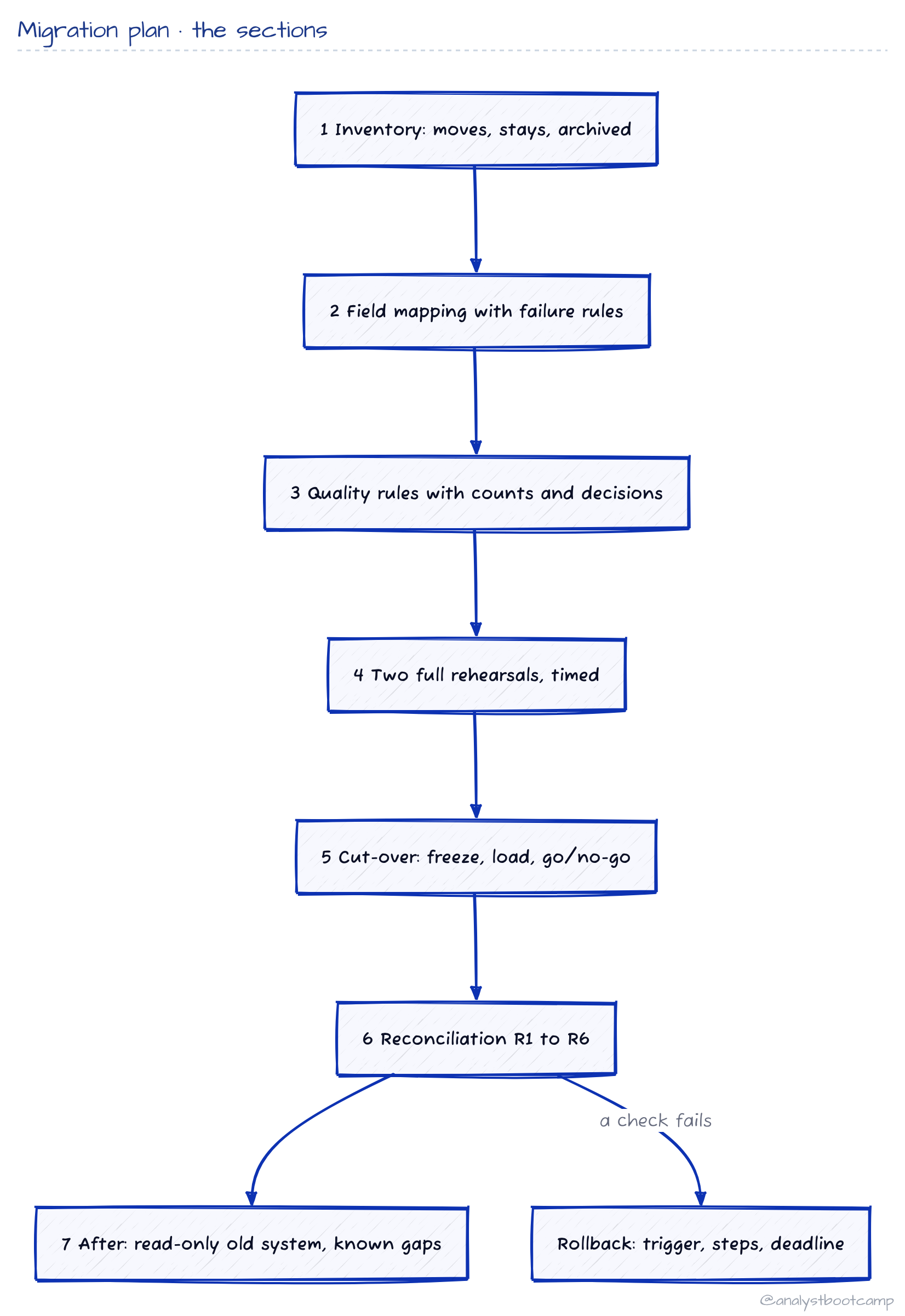
A migration plan prevents each of those with one section. It is not a technical document; it is the set of decisions a developer cannot make alone, written down before the first test run.
Section 1: scope and the inventory
What moves, what stays, what is archived. One table of entities with counts:
| Entity | Records | Moves? | Note |
|---|---|---|---|
| Customers | 48,300 | yes | including inactive (legal retention) |
| Contacts (people at customers) | 112,000 | yes | duplicates to be merged, see rules |
| Opportunities | 9,400 open, 61,000 closed | open: yes; closed: last 3 years | older ones archived as read-only export |
| Activity log (calls, e-mails) | 2.1 M | last 12 months | the rest stays in a searchable archive |
| Attachments | 300 GB | links only | files stay in the document store |
The counts come from the old database today; they will be compared with the new one after the load. Everything marked "no" or "archive" gets a sentence about where it will live and who can read it.
Section 2: field mapping
One row per target field. This is most of the document, and most of the work, and it is where the 8% phone problem is found before it happens.
| Target field | Source field | Transformation | Rule when it fails |
|---|---|---|---|
| customer.name | ACCOUNT.NAME | trim; collapse double spaces | required: reject row, report |
| customer.phone | ACCOUNT.TEL1, ACCOUNT.TEL2 | normalise to E.164; prefer TEL1 | if neither parses: load empty, flag for review |
| customer.owner | ACCOUNT.REP_CODE via code table | map REP_CODE → user id | unknown code: assign to "Unassigned", report |
| customer.segment | derived | revenue last 12 months → S/M/L thresholds | — |
| customer.createdAt | ACCOUNT.CREATED | parse dd/mm/yyyy | missing: use first activity date |
| contact.email | CONTACT.EMAIL | lower-case; validate format | invalid: load empty, flag; duplicates merged by rule M1 |
Three columns the developer cannot fill: the transformation rule, the failure rule, and the code-table mapping. Those are business decisions. "Prefer TEL1" is a decision; "assign unknown reps to Unassigned" is a decision. Get them from the data owner and write their name under the table.
Section 3: data quality rules
Before the load, run the rules against the source and publish the counts. The owner then decides for each: clean in the old system, clean during migration, or accept.
-- Q1 duplicate contacts: same lower(email) under the same customer
SELECT lower(email), account_id, count(*) FROM contact
GROUP BY 1, 2 HAVING count(*) > 1;              -- 3,180 groups

-- Q2 phones that parse in neither column
SELECT count(*) FROM account
WHERE NOT parses_e164(tel1) AND NOT parses_e164(tel2);   -- 3,900 (8.1%)

-- Q3 unknown rep codes
SELECT rep_code, count(*) FROM account
WHERE rep_code NOT IN (SELECT code FROM rep_map) GROUP BY 1;   -- 4 codes, 1,200 rows
The numbers go in the plan with a decision next to each: Q1 merge by rule M1 (keep the most recently active); Q2 load empty and give sales a list; Q3 two codes are retired reps → "Unassigned", two are typos → fixed in the old system this week.
Section 4: trial runs
Nothing goes live on the first run. The plan schedules at least two full rehearsals on a copy, each ending with the reconciliation checks (Section 6) and a list of defects. The rehearsal also measures how long the load takes, which decides whether the cut-over fits in a night or needs a different approach.
Section 5: cut-over sequence
Minute by minute, with owners and a go/no-go point:
Fri 18:00  Freeze: old CRM read-only (banner + permissions). Owner: IT
Fri 18:15  Final export (counts recorded). Owner: data team
Fri 18:30  Load + transformations (rehearsed: 2 h 40 m). Owner: dev
Fri 21:30  Reconciliation checks R1–R6 run; results to the channel. Owner: analyst
Fri 22:00  Go / no-go. Decider: head of sales ops. No-go → rollback plan
Sat 09:00  Smoke test by 5 sales users with a script (20 min). Owner: analyst
Mon 08:00  New CRM live; old CRM read-only for 90 days; support macro updated
The freeze is the line that prevents "which records were touched since the export". If a freeze is impossible (24/7 operations), the plan needs a delta load: capture changes after the export and apply them after the main load, which is a different, harder project and should be named as such.
Section 6: reconciliation checks
How you know the load worked, written before the load:
- R1 counts per entity: source (after freeze) = target, with the "no / archive" exclusions explained.
- R2 sums: total open opportunity value, by owner, equal to the cent.
- R3 samples: 30 customers chosen beforehand (biggest, oldest, odd ones) compared field by field by a person.
- R4 referential: no contact without a customer; no opportunity without an owner.
- R5 quality decisions applied: Q1 duplicates = 0 in target; Q3 unknown codes = 0.
- R6 a day in the life: a sales user finds their top ten accounts and last week's activities.
Section 7: after
Old system read-only for a retention period; a list of known gaps (the 3,900 empty phones) with an owner; the archive location for what did not move; a review two weeks later of what users report. Migrations are judged a month after the weekend, not on Monday.
With AI
A model will draft a credible plan skeleton and can write the quality queries from your column names. It cannot make the mapping decisions, set the thresholds, or choose who decides at 22:00 on Friday. Use it for structure and SQL; every transformation and failure rule needs a named owner.
Try it (5–10 minutes)
Migration: "Move the help-desk tickets from the old tool to the new one: 40,000 tickets, 2,000 open, 15 agents, 8 statuses in the old tool, 5 in the new."
- Write the inventory with a decision for closed tickets and attachments.
- Map the 8 statuses to 5 (invent them) with a failure rule, and map "assigned agent" with a rule for agents who left.
- Write the cut-over sequence with a freeze, a go/no-go, three reconciliation checks and the rollback trigger.
Where this shows up in real work
- System analyst and data migration analyst job posts ask for "data mapping", "migration planning" and "reconciliation"; interviewers ask what you check after the load.
- In real projects the field-mapping table with failure rules is the most reused document: it becomes the test plan, the user communication and the audit evidence.
- Freelance "move us from X to Y" projects are priced by the mapping table; the analyst who produces it in the first week sets the realistic timeline.
Sources worth reading
Practice it on real drills
Data migration / cut-over planReverse-engineering legacy behaviourData model for a new feature