 Analyst Bootcamp
A story is a promise to talk, not a spec
As a customer, I want to save my address so that I do not retype it on every order.
That sentence is not the requirement. It is a reminder of who benefits, what they get and why, so that the team can have the right conversation at refinement. The details (acceptance criteria, edge cases, fields) come out of that conversation and get attached to the story. If you treat the sentence as a complete spec, you get stories like "As a user, I want a button" and nobody knows why.
The three parts carry real information only when they are specific:
| Part | Weak | Useful | Why it matters |
|---|---|---|---|
| As a | user | returning customer with an account | tells the team whose edge cases to think about |
| I want | address management | to save a delivery address at checkout | names the behaviour, not a screen |
| So that | it is better | I do not retype it next time | lets the team propose a cheaper way to get the same benefit |
If you cannot write the "so that", the story is probably a task somebody asked for, not a need. Ask question 2 from The questions that unblock a ticket: what problem does this solve today?
INVEST: the six checks before a story enters a sprint
Bill Wake's INVEST list is twenty years old and still the fastest review of a story. Run it as six yes/no questions:
| Letter | Question | What "no" looks like |
|---|---|---|
| Independent | Can it be built and released without another story going first? | "Depends on PAY-412 being merged" |
| Negotiable | Is the how still open? | The story prescribes a modal, a table name and a library |
| Valuable | Does someone outside the team notice when it ships? | "Refactor the address service" |
| Estimable | Can the team put a number on it in refinement? | Three open questions in the ticket |
| Small | Does it fit comfortably inside one sprint, with room for others? | The team says "it is a 13, maybe 20" |
| Testable | Can a tester say pass or fail without asking? | "Address saving should be user-friendly" |
Two of these fail most often at Junior+ level: Small and Testable. Testable is fixed by acceptance criteria (first topic of this level). Small is fixed by splitting, which is the rest of this page.
Splitting: by value, never by layer
The wrong way to split a big story is into "backend", "frontend", "database". Each piece is small, none is valuable, and nothing can be released until all three are done. The right way is to find a thinner slice that still goes end to end and still helps someone.
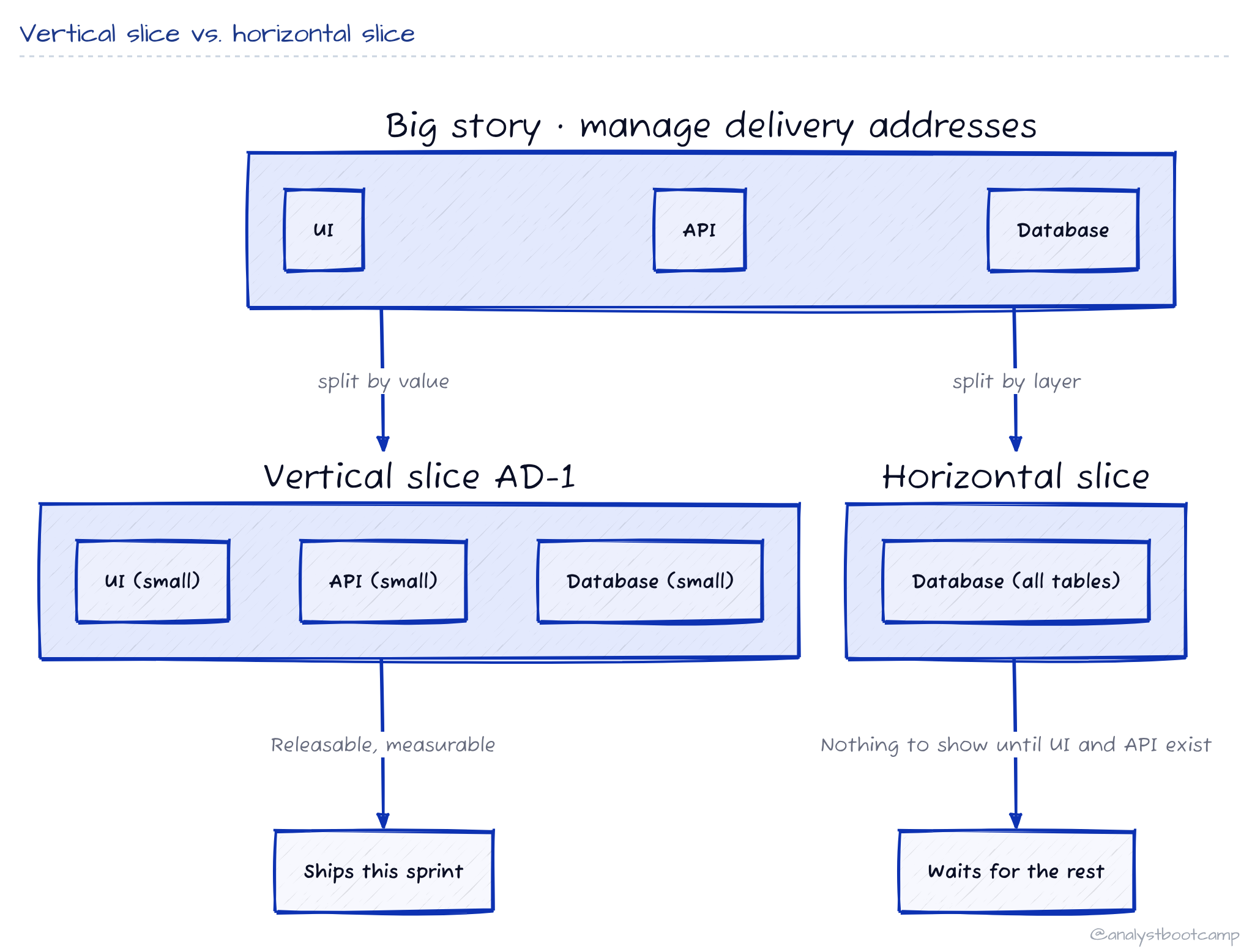
Seven splitting patterns cover almost every big story (from Richard Lawrence's story-splitting guide and the Humanizing Work cheat sheet):
- Workflow steps. "Place an order" → browse, add to cart, pay, confirm. Ship the thin version of each step first.
- Business rule variations. "Calculate delivery fee" → flat fee first; by weight next; by zone after that.
- Simple / complex. "Search for products" → by exact name first; filters and typo tolerance later.
- Data variations. "Import customers" → from CSV first; from the old CRM export later.
- Interface variations. "Notify the customer" → e-mail first; SMS and push later.
- Defer performance. "Show the report" → it can take 20 seconds for now; make it fast as a separate story once someone needs it.
- Happy path first, then each failure. "Pay by card" → successful payment; then declined; then timeout.
A worked example. The original story:
As a customer, I want to manage my delivery addresses so that checkout is faster.
Too big: it hides add, edit, delete, default address, validation and the checkout change. Split by workflow step and happy path first:
AD-1  Save the address used at checkout (one address, no editing)  → ships value: next order is faster
AD-2  Choose between saved addresses at checkout (up to 5)         → needs AD-1
AD-3  Edit or delete a saved address from the account page         → needs AD-1
AD-4  Validate the postcode against the carrier's list on save     → business rule variation
AD-5  Mark one address as default                                  → simple/complex
AD-1 alone is releasable and measurable (repeat orders with a saved address). The original story would have waited for all five.
Stories versus tasks versus epics
- Epic: a goal that takes several sprints ("Faster checkout"). Has an outcome and a metric, not acceptance criteria.
- Story: one releasable slice of an epic, with acceptance criteria. Estimated by the team.
- Task: a step the team takes to finish a story ("add the migration", "update the API docs"). Owned by the team; the analyst does not write these.
When you see "As a developer, I want a database index so that queries are fast", it is a task wearing a story template. Attach it to the story whose acceptance criterion it serves.
Writing the story in the ticket
A refinement-ready story in most trackers has this shape, top to bottom:
- the story sentence;
- two or three lines of context (numbers, the problem, links to the process map or the decision table);
- acceptance criteria as Given/When/Then or a checklist;
- out of scope, with the deferred slices named ("AD-2…AD-5 follow");
- open questions with an owner.
That is the whole document. Longer stories get skimmed, and the part that gets skipped is usually the acceptance criteria.
With AI
Models are good at proposing splits: paste the big story, ask for five vertical slices with the pattern used for each, and you will get a workable first cut. Check two things by hand: that each slice is still valuable on its own (models love "set up the data model" as slice one) and that the first slice is the one your stakeholder actually wants first.
Try it (5–10 minutes)
Take this story: "As a manager, I want to approve my team's expense claims so that people get paid on time."
- Run INVEST. Which letters fail and why?
- Split it into four or five slices using at least three different patterns. Name the pattern next to each slice.
- Pick the first slice and write its acceptance criteria (three to five, one of them a failure case).
Where this shows up in real work
- Junior+ BA and product analyst job posts ask for "writing user stories and acceptance criteria" and "backlog refinement"; interview tasks hand you an epic and ask you to split it.
- In real sprints the question "can we split this?" comes up when a story is estimated at the top of the scale; the analyst who answers with a slice, not a layer, keeps the sprint predictable.
- Freelance product briefs are usually one big story; the first deliverable that wins trust is a split backlog with a releasable first slice.
Sources worth reading
Practice it on real drills
User stories & acceptance criteriaDecomposition for the teamScope cut & prioritization (MVP)