 Analyst Bootcamp
The requirement nobody wrote
A reporting feature passes every acceptance criterion. On the first working day of the month, 300 managers open it at 09:00, the query takes 40 seconds each, the database locks, and checkout goes down. Nothing in the ticket was wrong; something was missing. Non-functional requirements (NFRs) are the missing part: not what the feature does but how well, how often, for how many and under what rules.
The problem with NFRs is not that teams forget them. It is that they get written as adjectives: "fast", "secure", "scalable", "user-friendly". An adjective cannot fail a test. This topic turns the adjectives into lines a tester can check.
The seven lines
For a Junior+ ticket, seven questions cover most of the risk. Ask them; write a line only where the answer is not "same as everything else in the system".
| # | Line | Weak | Testable |
|---|---|---|---|
| 1 | Load | "many users" | "300 concurrent users at 09:00 on the first working day of the month" |
| 2 | Response time | "fast" | "the report opens in under 3 s for 95% of requests at that load" |
| 3 | Availability | "always up" | "report may be unavailable up to 4 h/month; checkout must not be affected" |
| 4 | Data volume and retention | "store the data" | "12 months of history online, older archived; 50k rows/day" |
| 5 | Security and access | "secure" | "managers see only their own team; access logged; export needs the finance role" |
| 6 | Compliance | "GDPR" | "personal data limited to name and employee id; deletion within 30 days of leaving" |
| 7 | Operability | "monitored" | "alert on-call if report errors exceed 1% over 5 minutes" |
Each testable line has a number, a condition and a boundary. If one of the three is missing, ask again.
Where the numbers come from
You will not know the numbers. That is fine; your job is to find who does.
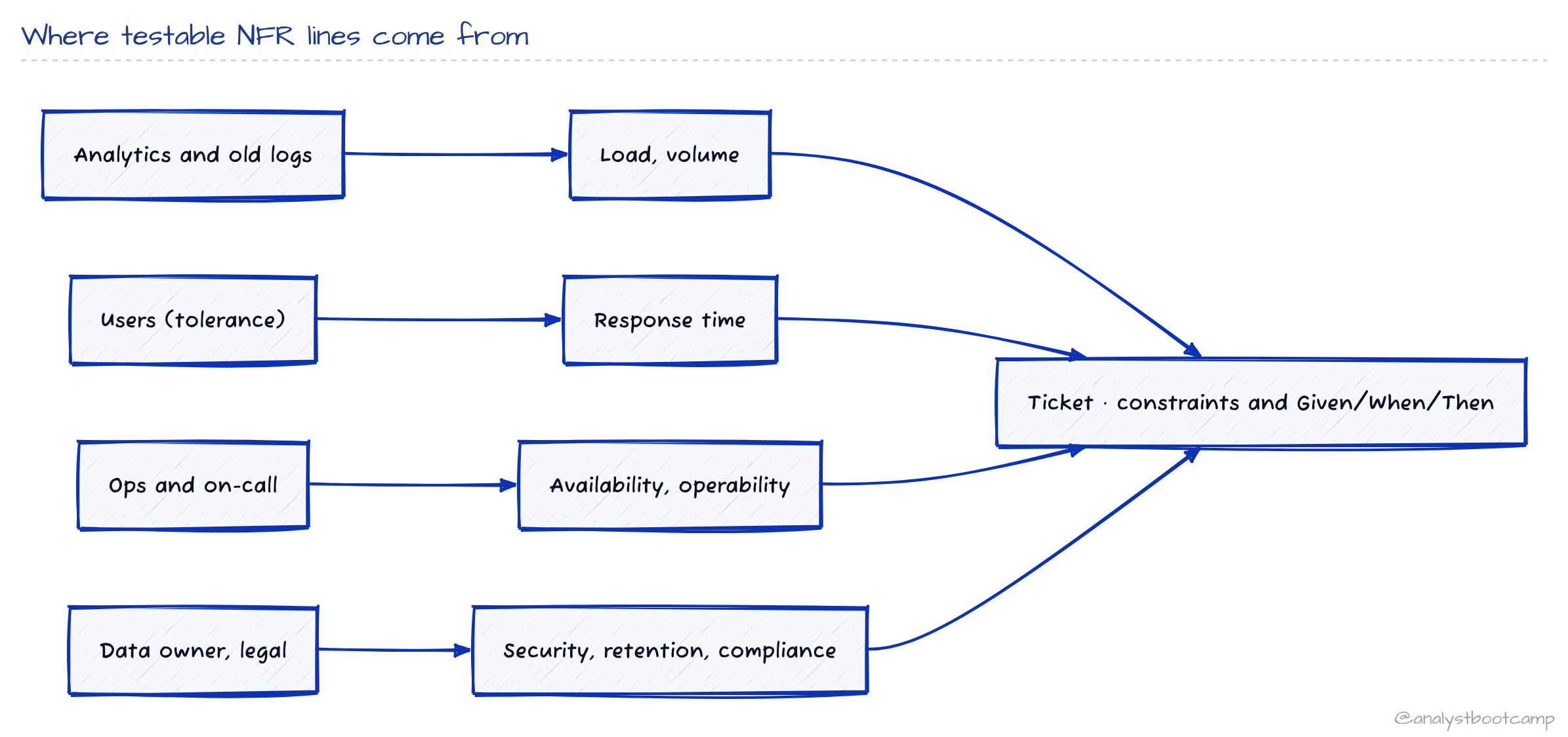
- Load and volume: analytics or the previous system's logs. "How many opened the old report last month, and when?" is a five-minute query for someone.
- Response time: the user's tolerance, not the technical possibility. For a monthly report 3 seconds is fine; for a search box 300 ms. Ask "what would make you stop using it?".
- Availability: the business cost of an outage. If nobody can say, the feature is not critical, and the line can say "best effort, outside the checkout availability target".
- Security and compliance: whoever owns the data (a manager, a DPO, legal). Do not guess; a wrong retention line is worse than none.
When nobody can give a number, write the assumption and name it: "Assumed 300 users at peak (based on 240 last month); to be confirmed by Ops." A labelled assumption is testable; silence is not.
Writing them where they get read
NFRs go into the ticket in two places:
- As acceptance criteria, when they are specific to this feature: a Given/When/Then with the load in the Given and the time in the Then.
- As a short "constraints" section, when they are inherited from the system: "inherits the platform targets: 99.9% availability, data in EU region, audit logging".
A pattern that works:
Scenario: Monthly report under peak load
Given 300 managers open the monthly report within the same 10 minutes
When each report is generated
Then 95% of them are returned within 3 seconds
And checkout response time does not degrade by more than 10%
The "And" line is the one that would have prevented the incident at the top of this page. It states the thing that must not change, which is what NFRs are mostly about.
Which lines to skip
Not every ticket needs seven lines. Skip a line when:
- the feature inherits a documented platform target and does not change the risk (a new button on an existing page);
- the answer is "same as the rest of the system" and that is written somewhere you can link;
- the stakeholder cannot give a number and the cost of being wrong is low (an internal tool used by five people).
What you must not skip: any line where a wrong guess causes an incident, a fine or a data breach. Load on a shared database, retention of personal data and access to money or health data are never "same as everything else".
A second example: a customer-facing form
The same seven lines, for a very different feature, a complaints form on a public website:
- Load: up to 2,000 submissions/day; spikes of 50/minute after a TV mention.
- Response time: form submits in under 2 s; confirmation e-mail within 5 minutes.
- Availability: 99.5% monthly; if the backend is down, the form stores submissions and retries.
- Data and retention: complaint text and contact details kept 24 months, then deleted; attachments up to 10 MB, three per complaint.
- Security and access: only the complaints team sees submissions; no personal data in logs; rate limit 5 submissions per IP per hour.
- Compliance: privacy notice linked on the form; data stored in the EU.
- Operability: alert if the submission error rate exceeds 2% for 10 minutes; dashboard with submissions per hour.
Seven lines, fifteen checkable statements. Each statement is a test, and three of them (retry on backend down, no personal data in logs, rate limit) are features the developer would not have built from the functional story alone.
With AI
Models produce a credible NFR list for any feature, which is exactly the danger: the numbers will be generic ("response time under 2 seconds", "99.9% uptime") and nobody will have agreed to them. Use a model to generate the questions, then get the numbers from the sources above. A number with no owner is an adjective in disguise.
Try it (5–10 minutes)
Feature: "Customers can download their full order history as a PDF from the account page."
- Write the seven lines. For each, say who you would ask for the number and write a labelled assumption in the meantime.
- Turn the two riskiest lines into Given/When/Then.
- Which lines would you skip for this feature, and why?
Where this shows up in real work
- System analyst job posts list "non-functional requirements" explicitly; BA posts hide it under "quality attributes" or "constraints". Interviewers ask "what did you forget?" after you present a functional spec.
- In real post-mortems the root cause is often "no load requirement" or "retention never defined"; the ticket that had the line is the one that gets quoted as the example.
- Freelance briefs almost never contain NFRs; the first question that makes a client trust you is "how many users on the first day, and what happens if it is ten times more?".
Sources worth reading
Practice it on real drills
Non-functional requirementsRegulatory / policy change adoptionEnd-to-end feature spec (business + system)