 Analyst Bootcamp
"Can we just…"
"Can we just change the order number format to include the country code? Finance needs it for the new ERP."
Every "can we just" is a change to a system people depend on. Saying yes without looking is how you discover, two weeks later, that the carrier labels truncate the number, the support search breaks, and the old numbers in e-mails stop matching. Saying no without looking is how finance builds a spreadsheet workaround that lives for five years.
The analyst's answer is neither. It is a one-page impact note that lets the right person decide in five minutes. The page has six parts and takes about an hour for a change of this size.
The six parts
| Part | Question it answers | Length |
|---|---|---|
| 1. Change | What exactly is being asked, by whom, by when? | 3 lines |
| 2. Reason | What problem does it solve, and what happens if we do nothing? | 3 lines |
| 3. Touches | Which systems, screens, documents, integrations and reports see this thing? | a list |
| 4. Options | Two or three ways to do it, including the minimal one | a table |
| 5. Cost and risk | Effort estimate per option, what could break, how we would know | a table |
| 6. Decision | What you recommend, who decides, by when | 3 lines |
The parts are in the order a busy reader needs them. Most readers stop at part 4 with enough to decide; the rest is for the team.
Part 3 is the work: finding what it touches
The order number looks like one field. Trace it the way you would trace a request in logs: where is it created, where is it stored, where is it displayed, where does it leave the system?
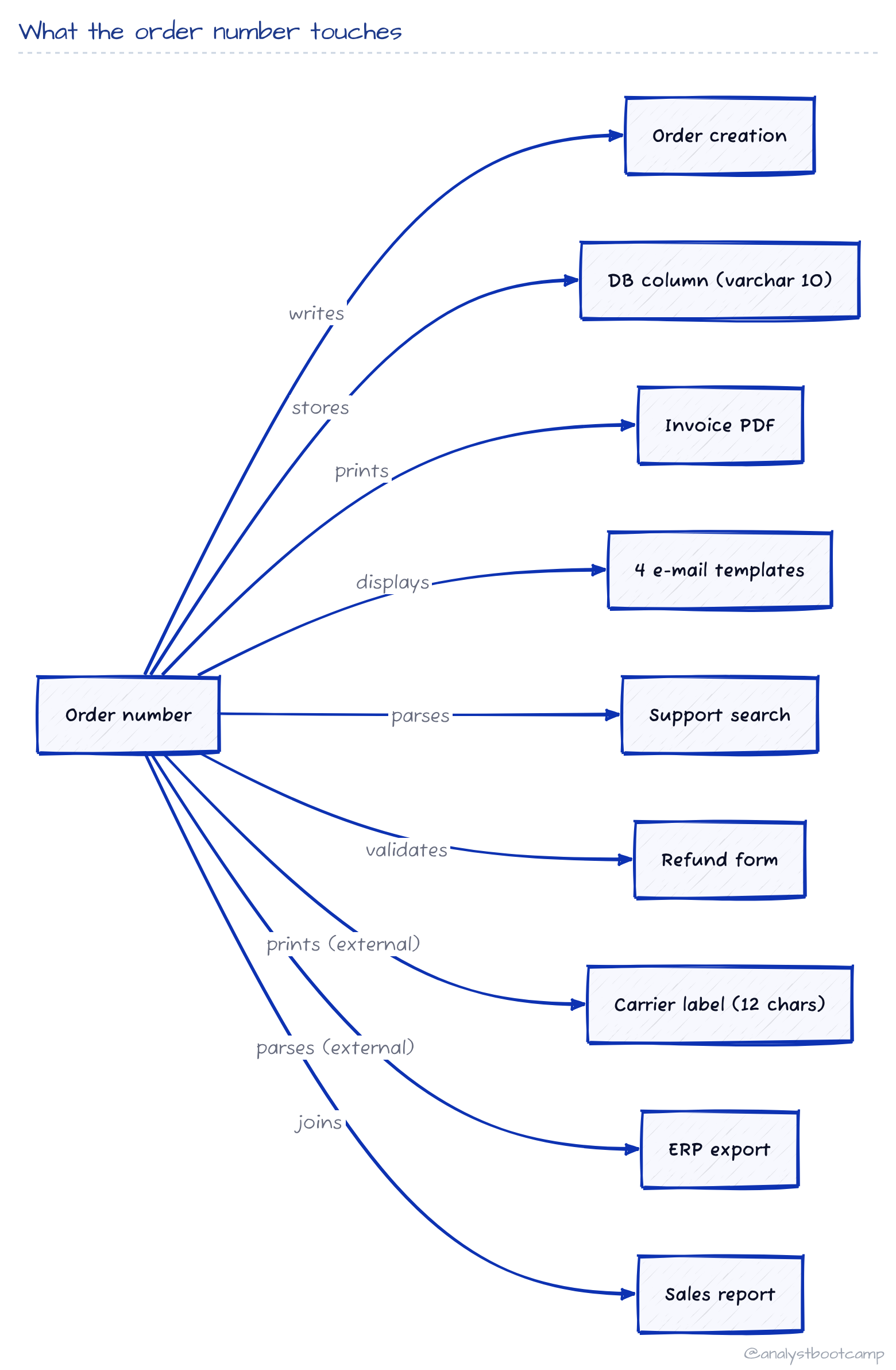
A practical way to find them in an hour:
- Search the code and the documents for the field name and its variants (order_no, orderNumber, "Order #"). Ask a developer to run the search; it takes them two minutes.
- Walk the process map from the earlier topic: every lane that reads or shows the order number is a touch point.
- Check the integrations list: carriers, payment provider, ERP, e-mail templates, the warehouse scanner. External partners who parse the field are the expensive ones.
- Check the reports: anything that joins on the order number, and anyone who pastes it into a spreadsheet.
- Ask support: "where do you type order numbers?" finds the search box, the refund form and the two tools nobody documented.
Write the list with one word per item on how it is affected: display, parse, join, validate, print.
Parts 4 and 5: options with honest costs
The person asking usually has one solution in mind. Your job is to put at least one cheaper and one safer option next to it.
| Option | What changes | Effort (team estimate) | Risk |
|---|---|---|---|
| A. Change the format everywhere | new numbers for new orders; old numbers stay | ~3 weeks; 11 touch points, 2 external | carrier label length; support search must handle both formats |
| B. Keep the number, add a country field | ERP gets a separate field; nothing else changes | ~3 days; 2 touch points | ERP mapping must be confirmed with finance |
| C. Derive it in the export only | the ERP export composes "DE-" + number | ~1 day; 1 touch point | two identifiers for the same order in two systems |
Effort comes from the team, not from you; your contribution is the touch-point list that makes their estimate honest. Risk is "what could break and how we would notice", not a probability.
Part 6: a recommendation, not a menu
End with a sentence a decision-maker can accept or reject: "Recommend option B: it gives finance what they need by the ERP go-live on 1 Nov, touches two systems, and leaves the order number stable for customers and carriers. Decision needed from the Head of Operations by 18 Oct; after that the ERP mapping cannot change before go-live."
Three things make that sentence work: a named option, a reason tied to the requester's deadline, and a named decider with a date.
The whole note
CHANGE REQUEST CR-23 · Country code in order numbers
Requested by: Finance (Lena K.), for the ERP go-live on 1 Nov 2026

1. Change: order numbers to carry the shipping country, e.g. DE-1045321 instead of 1045321.
2. Reason: the ERP posts revenue per country and keys on the order number. Do nothing:
   finance keys the country manually, ~2 h/week, with errors in last month's trial.
3. Touches (9): order creation, DB column (varchar 10), invoice PDF, 4 e-mail templates,
   support search, refund form, carrier label (max 12 chars), ERP export, sales report.
4. Options: A change everywhere · B add a country field · C compose in the export only.
5. Cost/risk: A ~3 wk, carrier + support risk · B ~3 d, ERP mapping to confirm · C ~1 d, two ids.
6. Recommendation: B. Decide by 18 Oct (Head of Ops). Then: ERP mapping with finance, one story.
Eleven lines. The reader knows what, why, how big, and what to do next, and the team has a touch-point list to build from.
When the note says no
Sometimes the honest note recommends against the change: the cost is higher than the problem, or the deadline is impossible. Say so in part 6, with the do-nothing cost next to it, and offer the smallest thing that helps ("C now, B after go-live"). A clear no with a reason keeps the requester's trust; a quiet "we'll look at it" loses it.
With AI
A model is useful for the search in part 3 if it can see the code or the documents: "list every place the order number is read, written or displayed" is a good prompt for a code assistant. It is not useful for parts 4 and 5 unless it knows your systems; it will produce generic risks ("data inconsistency") and effort numbers with no basis. Use it to find, not to estimate.
Try it (5–10 minutes)
Change request: "Marketing wants customers to be able to change the e-mail address on their account themselves. Today support does it."
- Write the six parts. For part 3, list at least eight touch points (think: login, notifications, invoices, marketing lists, the CRM, fraud checks).
- Give three options including a minimal one, with your guess at relative effort and the main risk of each.
- Write the recommendation sentence with a named decider and a date.
Where this shows up in real work
- Junior+ BA job posts list "impact analysis" and "change request management" as core; interviewers give you a small change and ask what it touches.
- In real teams the impact note is what turns a Slack "can we just" into a planned story instead of an emergency; stakeholders learn to ask for "the one-pager".
- Freelance and agency work bills change requests separately; the client who gets a clear note with options and costs approves faster and disputes less.
Sources worth reading
Practice it on real drills
Change impact analysisScope cut & prioritization (MVP)Data migration / cut-over plan