 Analyst Bootcamp
The person you forgot
A team ships a new invoice layout. Finance signed it off, the designer loved it, and on day two the legal team blocks the release because the VAT footer moved. Nobody asked legal. Nobody knew to ask legal.
That is a stakeholder problem, and it is cheaper to solve with a sheet of paper before the first ticket than with a rollback after the release. The two tools are a stakeholder map (who cares, how much power do they have) and a RACI table (for this feature, who does what).
Step 1: list everyone who is touched
Start wide and prune later. Go through four groups:
| Group | Ask | Typical finds |
|---|---|---|
| Users | Who uses the feature daily, occasionally, by accident? | agents, managers, customers, the night shift |
| Owners | Who pays, who is measured on the result? | the product owner, a department head, the budget holder |
| Gatekeepers | Who can block it after it is built? | legal, security, compliance, brand, works council |
| Operators | Who keeps it running and answers the calls? | support, ops, the data team, the integration partner |
The third group is the one juniors miss. A practical trick: look at the last three releases and ask "who complained after each one?". Those names go on the map.
Step 2: the map
Place each person or group on two axes: influence (can they change or stop the decision?) and interest (how much does this feature affect them?). Four quadrants, four behaviours:
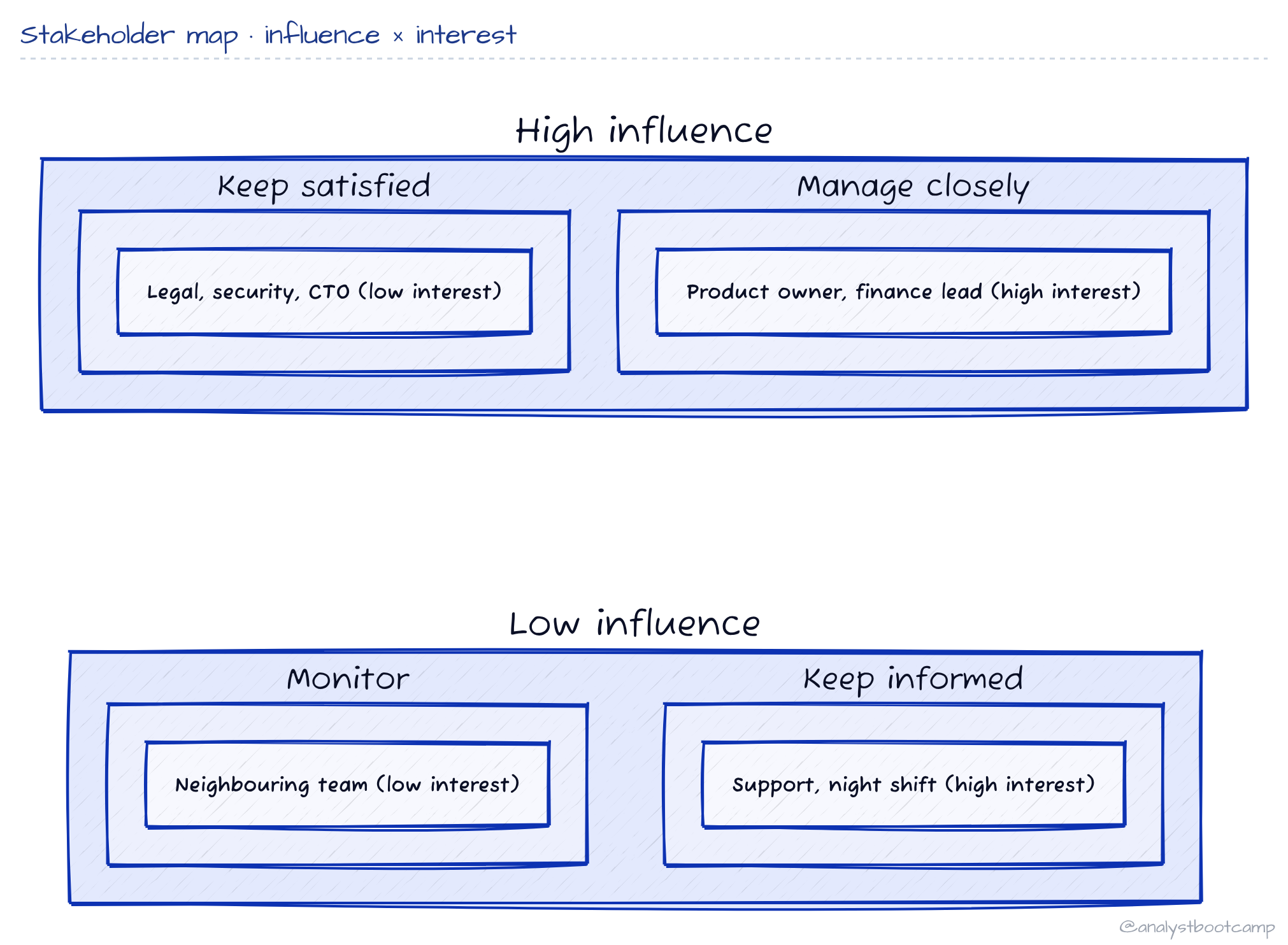
- High influence, high interest (product owner, head of finance): manage closely. Weekly contact, decisions in writing, no surprises.
- High influence, low interest (legal, security, the CTO): keep satisfied. Ask the specific question early, get the answer in writing, then leave them alone.
- Low influence, high interest (support agents, the night shift): keep informed, and listen: they know where the current process breaks.
- Low influence, low interest (a neighbouring team): monitor. A line in the release notes.
The map is a judgement, not a measurement, and it changes. Legal has low interest until the VAT footer moves. Re-check it when scope changes.
Step 3: RACI for this feature
A RACI table assigns one letter per person per decision or deliverable:
- Responsible: does the work.
- Accountable: makes the call and owns the result. Exactly one per row.
- Consulted: must be asked before the decision; their input can change it.
- Informed: told after the decision; cannot change it.
For the invoice layout:
| Decision / deliverable | Product owner | Finance lead | Legal | Designer | Support lead | Dev team |
|---|---|---|---|---|---|---|
| Layout and content of the invoice | A | C | C | R | I | I |
| VAT and legal text | I | C | A | R | — | I |
| Release date | A | I | I | — | C | R |
| Support macros and FAQ update | I | — | — | — | A/R | C |
Three things the table did that the meeting would not:
- It made legal accountable for the legal text, not merely consulted: nobody else can sign that row.
- It put support as consulted on the release date, because they staff the inbox on day one.
- It exposed a row with no accountable person until someone was named (support macros), which is exactly the kind of work that silently does not happen.
Using the map in the week
The map and the table are only useful if they change what you do on Tuesday:
- Before refinement: the C column is your interview list. Each consulted person gets the specific question, with a proposal attached (see The questions that unblock a ticket).
- Before the decision: the A person gets the options note (see The change request). Nobody else "approves".
- After the decision: the I column gets one message. Copying everyone on every thread is how people stop reading you.
- When someone new appears: add them, place them, and ask what they would have blocked. Then thank the person who pointed them out.
When the map is political
Sometimes the real decider is not the official one, or two leaders disagree and both believe they are accountable. The map does not solve that, but it surfaces it early, which is when it is cheap. Write the row with the two names and a question mark, and ask your product owner or manager, in private, who it should be. That is a normal Junior+ question; guessing is not.
With AI
A model can generate a generic stakeholder list for "an invoice change in an e-commerce company" and it will be a decent checklist to prune. It cannot know that your legal team reviews invoices or that support is staffed by an agency. Use it for the long list, then do steps 2 and 3 with people who know the building.
Try it (5–10 minutes)
Feature: "Customers can book a call-back from support instead of waiting on the phone."
- List the stakeholders in the four groups. Find at least one gatekeeper and one operator you did not think of at first.
- Place them on the map. Who is high influence, low interest, and what is the one question you must ask them early?
- Build the RACI for three rows: call-back rules (hours, slots), the phone system change, and the launch communication. Check the A column.
Where this shows up in real work
- Junior and Junior+ BA job posts list "stakeholder management" and "facilitate workshops"; interviewers ask "who would you talk to first and why" about a case.
- In real projects the RACI is the artefact steering committees ask for when something slips; having it before the slip is what makes you look senior.
- Freelance discovery work starts with a stakeholder interview plan; the map is how you decide whose hour to book first.
Sources worth reading
Practice it on real drills
Conflicting stakeholder requirementsElicitation: questions for stakeholdersRegulatory / policy change adoption