 Analyst Bootcamp
The number that ends the meeting
"Should we automate the duplicate-ticket merge?" can be debated for an hour or settled in a minute: it costs about 12 days of development, it saves about 5 agent-hours a day, so it pays back in under three months. Any stakeholder can check those three numbers, and the meeting moves on.
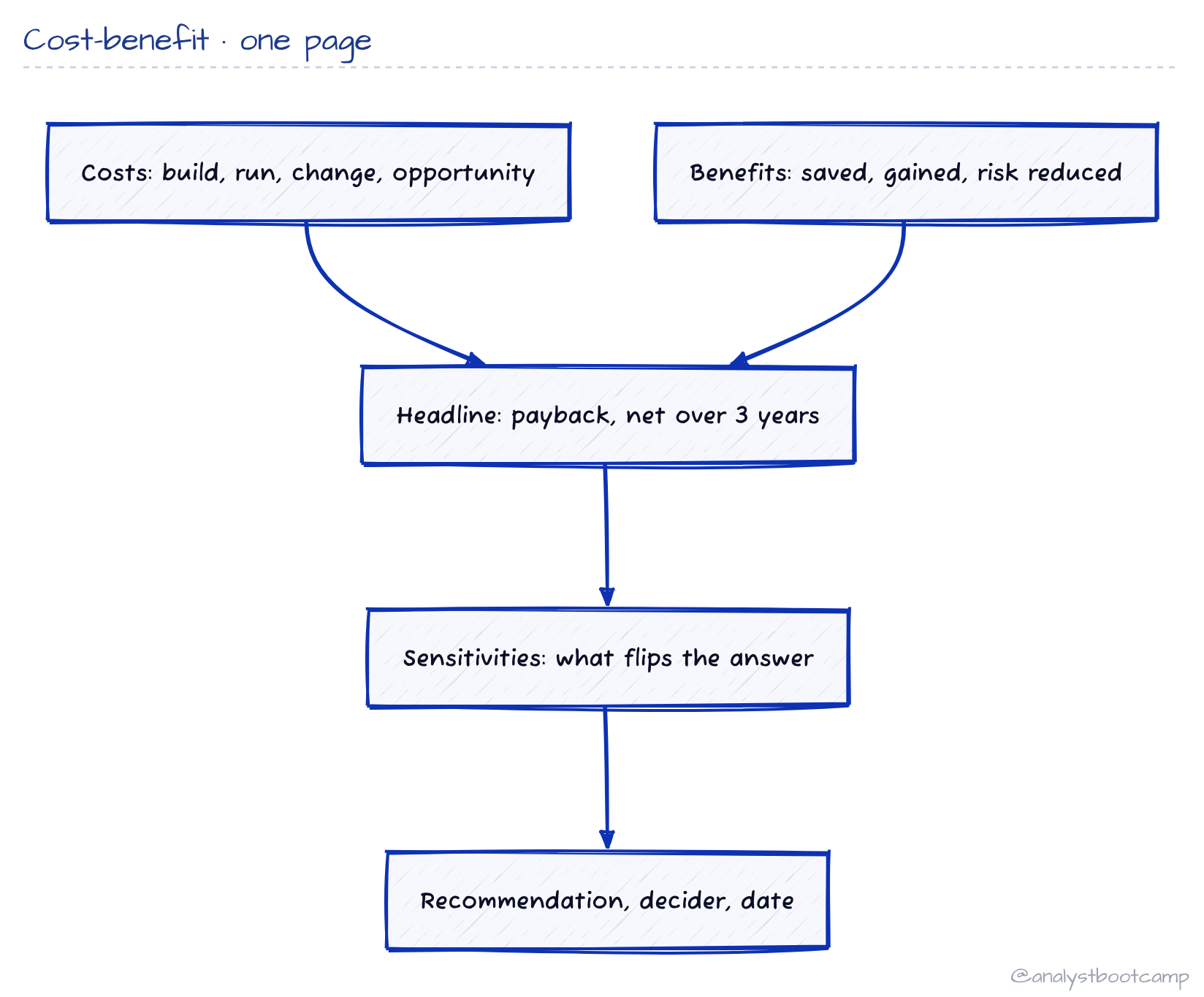
That is a cost-benefit analysis at the level a Junior+ analyst is asked for. Not a discounted cash flow, not a 30-page business case: one page, four parts, every number with a source.
Part 1: costs, all of them
Costs are easier to list than benefits, and still usually under-counted. Walk the list:
| Cost | What it includes | How to get a number |
|---|---|---|
| Build | development, testing, design, your own time | the team's estimate × a loaded day rate (ask finance for the rate; a common placeholder is 500–800 per developer-day in Europe) |
| Run | licences, hosting, API fees, a vendor subscription | the vendor's price list; the ops team for hosting |
| Change | training, documentation, support macros, the dip in productivity in the first weeks | hours of the people affected × their rate |
| Opportunity | what the team does not build while building this | name the item that moves; its cost of delay (see Prioritisation) |
Write each cost with a one-time or per-year label. Mixing them is the most common arithmetic error in these notes.
Part 2: benefits, counted honestly
Benefits come in three kinds; be clear about which kind each one is, because the first is far more credible than the third.
- Cost saved: hours that stop being spent, fees that stop being paid. Count only time that will actually be reallocated or not hired. "Agents save 20 minutes a day" is a benefit only if that time goes somewhere; say where ("absorbs the 15% volume growth without a new hire").
- Revenue gained: more orders, less churn, a new segment. Needs a baseline and a mechanism ("saved addresses raise repeat purchase by X", with X from a pilot or a comparable), not a hope.
- Risk reduced: fewer errors, fines avoided, outages prevented. Count as probability × impact, and say both numbers ("a 10% chance per year of a 50k fine ≈ 5k/year").
For the duplicate-merge feature:
Benefit: agent time on manual duplicate handling
  today:   15 agents × 20 min/day × 220 days = 1,100 h/year
  after:   ~10% remains (edge cases)                → ~990 h/year saved
  value:   990 h × 35/h (loaded, from finance)       ≈ 34,650/year
  use:     absorbs the forecast 15% ticket growth in 2027 without a new hire
Benefit: fewer double replies to customers (risk / quality)
  today:   ~3% of duplicate pairs get two conflicting answers; ~40 complaints/month
  after:   near zero; not monetised, listed as a quality benefit
The second benefit is deliberately not turned into money. A number you cannot defend weakens the ones you can.
Part 3: payback and the headline
With costs and benefits per year, two headline numbers are enough at this level:
- Payback period = one-time cost ÷ net benefit per year. 12 days × 650 ≈ 7,800 one-time; 34,650 per year ≈ 2,900 per month → payback in about 3 months.
- Net benefit over the horizon (usually 2 or 3 years): 3 × 34,650 − 7,800 − run costs. If there is a licence, subtract it per year.
Skip discounting and net present value unless finance asks. At three months of payback, discounting changes nothing; at three years, the decision is about something else anyway.
Part 4: what would make this wrong
The sentence that turns a sales pitch into analysis. List the two or three assumptions the result depends on most, and what happens if they are off:
| Assumption | If wrong | Effect |
|---|---|---|
| 20 min/day per agent (from a 1-week self-report) | real figure is 10 min | payback about 5.5 months; still worth it |
| time saved absorbs growth (no hire) | growth does not come | benefit is quality only; marginal |
| 12-day estimate | becomes 30 days | payback about 7 months; still worth it |
If the decision survives all three, say so: "robust to the estimates we are least sure of". If one of them flips it, that assumption becomes the first thing to verify (a two-week measurement of actual duplicate time, before the build).
The one page
Title, the question, costs (table), benefits (table, by kind), headline (payback, net over 3 years), sensitivities (table), recommendation with decider and date. Half a page of tables, a quarter page of prose, and the appendix is a link to the spreadsheet with the arithmetic.
When the answer is no
A cost-benefit that says "do not do this" is a success: it saved the twelve days. Say it plainly, keep the page, and note what would change the answer ("worth revisiting if ticket volume passes 1,200/day").
With AI
A model can lay out the template and check your arithmetic, and it is decent at listing cost categories you forgot (training, support content, the opportunity cost). It will make up rates and savings if you let it. Every number on the page needs a source you can name; the model is not a source.
Try it (5–10 minutes)
Proposal: "Replace the manual weekly sales report (built in Excel by an analyst) with an automated dashboard."
- List the costs in all four categories with plausible, sourced-looking numbers (name the imaginary source for each).
- List the benefits by kind. Which ones do you decline to monetise, and why?
- Compute payback and net benefit over 2 years. Then write the three assumptions that could flip the answer and what you would verify first.
Where this shows up in real work
- BA job posts ask for "business case support" and "cost-benefit analysis"; interviewers hand you a feature and ask "is it worth it, and how would you know?".
- In real teams the one-page cost-benefit is what gets a backlog item funded outside the roadmap; the analyst who brings it with sensitivities gets trusted with bigger ones.
- Freelance proposals are a cost-benefit for the client; the ones that show payback and the risks win against the ones that list features.
Sources worth reading
- IIBA BABOK Guide v3: Financial Analysis (technique: cost-benefit, payback, NPV)
- HM Treasury Green Book: appraisal and evaluation (the public-sector standard, readable chapters on costs and benefits)
- Harvard Business School Online: how to do a cost-benefit analysis
- Douglas Hubbard: How to Measure Anything (estimating what seems unmeasurable)
Practice it on real drills
Options appraisal (build / buy / do nothing)Scope cut & prioritization (MVP)Third-party service integration assessment