 Analyst Bootcamp
Why "it has all the fields" is not a review
Most API contracts you receive as a Junior+ system analyst look complete: endpoints, request and response schemas, a 200 and a 400. The problems that will cost your team weeks are not in what is written. They are in what is absent: what the server does with a duplicate request, how a client finds out that a list has a second page, which error means "retry" and which means "stop". Reading a spec is the discipline of asking those questions before the integration is built.
Below is the order in which to read any REST contract, with the question to ask at each step. It works for an OpenAPI file, a partner's PDF or a Confluence page.
1. Resources and identifiers
Find the nouns. For each one ask: what is its identifier, who issues it, is it stable?
paths:
  /orders/{orderId}:
    get:
      parameters:
        - name: orderId
          in: path
          schema: { type: string }
Questions this fragment leaves open: is orderId the merchant's order number or the provider's? If the provider issues it, when does the client learn it? If both exist, which one appears in webhooks? A contract that answers "string" and nothing else will produce two systems that disagree about which id they are talking about.
2. Operations and their side effects
For every POST, PUT, PATCH, DELETE ask: what changes, and what happens if the same call arrives twice? Networks retry; so do mobile clients and queue consumers. A POST /payments with no idempotency rule means double charges.
What to look for:
- an
Idempotency-Key(or similar) header and the statement of how long the server remembers it; - whether
PUTreplaces the whole object or only sent fields (this isPATCHterritory, and the two are mixed up constantly); - what
DELETEmeans: hard delete, soft delete, or "cancel".
If the spec is silent, write the question down with the exact endpoint. Do not assume.
3. Errors: the part nobody writes
Count the error responses. A contract with only 400 and 500 is telling you that error handling is undefined. The minimum a client needs:
| Situation | Status | What the client should do |
|---|---|---|
| Invalid input (missing field, wrong format) | 400 / 422 | Fix the request; never retry as is |
| Not authenticated / token expired | 401 | Refresh the token, retry once |
| Not allowed | 403 | Stop; surface to a human |
| Object not found | 404 | Decide: stale id or race (created a second ago)? |
| Conflict (duplicate, wrong state) | 409 | Read the current state, then decide |
| Rate limit | 429 | Wait as told by Retry-After, then retry |
| Server error | 5xx | Retry with backoff, then alert |
Then look at the error body. A good contract uses one shape for every error, with a machine-readable code and a human message. RFC 9457 ("Problem Details") is the standard shape; many providers use their own but equivalent format:
{ "type": "https://api.example.com/errors/insufficient-funds",
  "title": "Insufficient funds", "status": 409,
  "code": "insufficient_funds", "detail": "Balance is 12.40, requested 50.00" }
The question to ask: can a program decide what to do from this response without reading the message? If the only distinguishing part is the English text, every client will string-match it and break when the text changes.
4. Lists: pagination, filtering, ordering
Any endpoint that returns a list needs three answers: how do I get the next page, how do I get only what I need, and in what order do results come. Cursor pagination (next_cursor) is safer than page numbers when the underlying data changes between calls. Check the maximum page size and what happens if you exceed it (error or silent truncation: silent truncation is a data-loss bug waiting to happen).
5. Time, money, text
Three fields that are wrong in half of all contracts:
- Timestamps. ISO 8601 with an explicit offset (
2026-10-16T09:00:00+02:00) or UTC withZ. A bare2026-10-16 09:00is a bug: whose 09:00? - Money. Integer minor units (
amount_minor: 1250, currencyEUR) or a decimal string ("12.50"). Floating point numbers for money are a defect; raise it. - Text. Maximum lengths and encoding. "string" without a limit means your database column will be the first thing to find the limit.
6. Asynchronous parts: webhooks and callbacks
If the provider calls you back, read that section twice. The picture below is the classic trap: the webhook about the result arrives before the answer to the request that caused it.
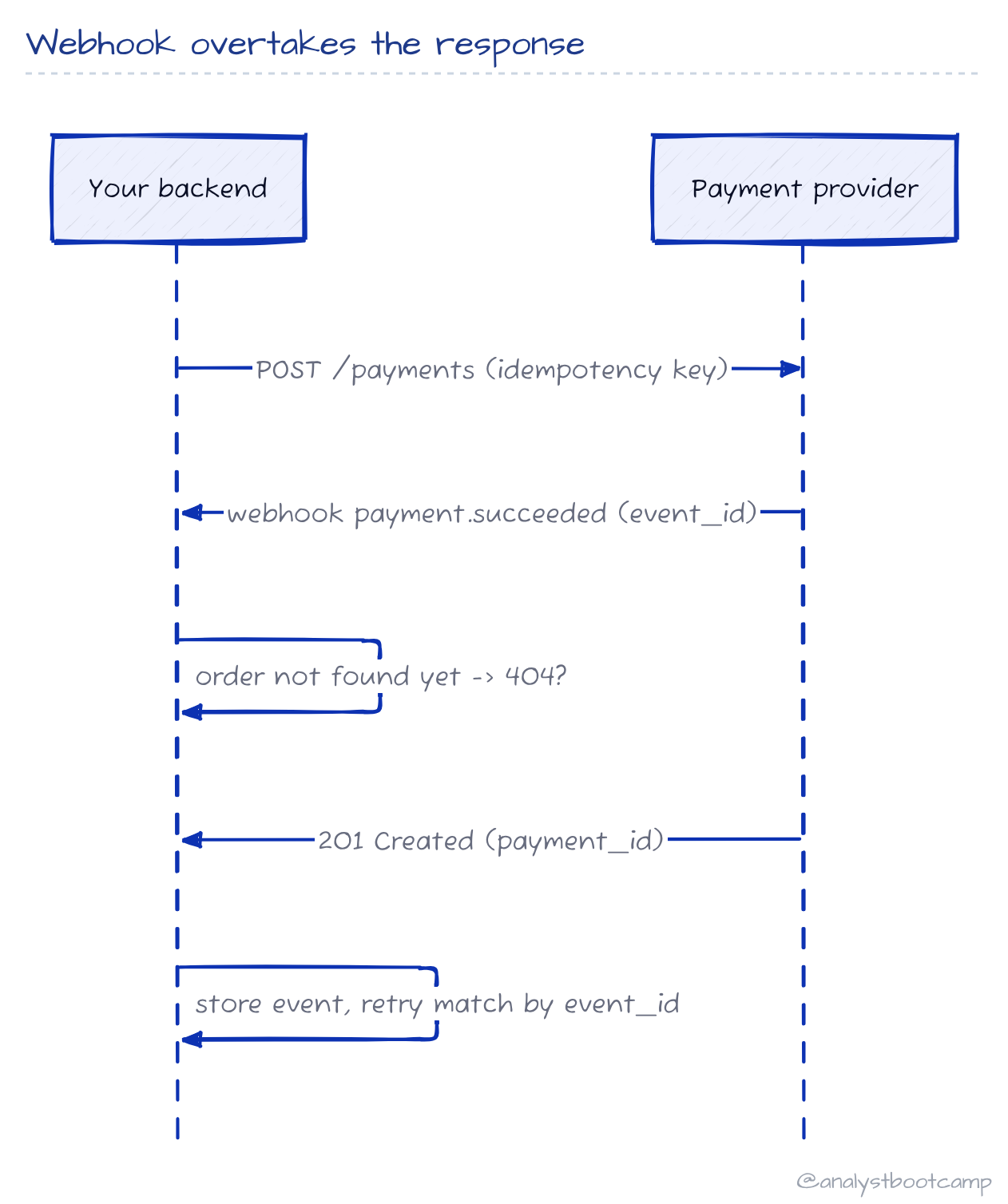
Questions:
- Delivery guarantees. At least once (you will get duplicates) or at most once (you may miss events)? Stripe, for example, states that events may be delivered more than once and asks you to deduplicate by event id.
- Ordering. Can "payment.succeeded" arrive before "payment.created"? Usually yes. Your handler must not assume order.
- Verification. How do you know the call is really from the provider: a signature header, a shared secret, an allow-list of IPs?
- Acknowledgement. What response stops the retries (usually any 2xx within N seconds), and what is the retry schedule?
A spec that does not answer these is not ready for an integration design. Those are the exact questions to send back.
7. Versioning and change
How will the contract change: a version in the path (/v2/), a header, or "we only add fields"? The last one is fine if your client ignores unknown fields; write that down as a requirement for your team. Ask for the deprecation policy: how long an old version lives after a new one ships.
Putting it together: the review note
The output of reading a spec is a short note, not a verdict. A good structure:
- Understood: the resources, ids and flows in two or three sentences, so the provider can correct you.
- Gaps: numbered questions, each pointing at an endpoint or field. "Section 4.2,
POST /refunds: behaviour on duplicate request is not specified. Proposal: acceptIdempotency-Key, 24 h window." - Risks for us: the two or three items that change our design (for example: at-least-once webhooks mean we need an events table with unique event ids).
- Proposed decisions: what you will assume if there is no answer by a date.
Using AI here
A model is useful for the mechanical part: paste the spec and ask it to list every endpoint with its error responses and whether pagination is defined. It is also decent at generating the gap list from the checklist above. It is unreliable at knowing the provider's actual behaviour: it will confidently describe retry policies that are not in the document. Everything it outputs about behaviour goes into the "questions" section, never into "understood".
Try it (5–10 minutes)
Open a real public contract, for example the Stripe API reference for creating a refund, or any provider your company uses.
- Run the seven steps above on one
POSTendpoint and one list endpoint. Time-box: 10 minutes. - Write the review note with at least four numbered gaps that point at specific fields or sections.
- Mark which gaps would change your team's design (events table, retry logic, id mapping) and which are just documentation.
Where this shows up in real work
- "Integration analyst" and "System analyst (API)" job posts ask for "experience reviewing API contracts / OpenAPI"; the interview task is usually a spec with deliberate gaps.
- In real tickets the phrase "the partner's API docs are incomplete" is the start of most integration delays; the review note above is what turns it into a plan.
- Freelance briefs "integrate X with Y" rarely mention errors, retries or webhooks; the analyst who asks about them wins the bid.
Sources worth reading
Practice it on real drills
Review a draft API contractREST API design for a featureIntegration between two systemsIdempotency & duplicate handling